Portfolio compliance in one system.
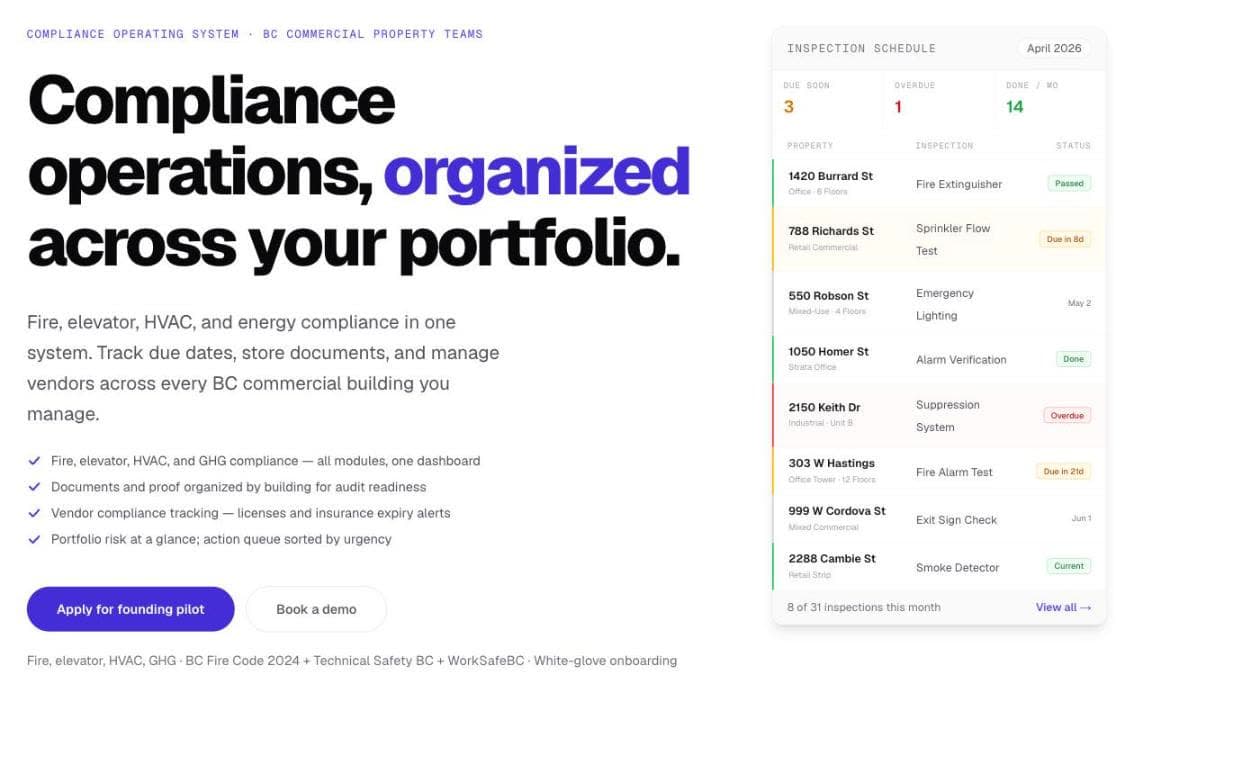
Elevate Compliance helps commercial property teams answer four questions across a portfolio of buildings: what is required, when is it due, who is responsible, and where is the proof. System Current designed and built the product — the relational data model, the multi-tenant security boundary, the authenticated application and the public product site.
Part of Elevate Facility Services Ltd.
Venture
Elevate Facility Services Ltd.
Division
Elevate Compliance
Market
BC commercial property teams
Product type
Multi-tenant SaaS
Data model
14 tables, organization-scoped
Security
Row Level Security on tenant tables
Compliance across a portfolio of buildings
A commercial property team has to know what is required, when it is due, who is responsible and where the certificate is — for every building, across fire, elevator, HVAC and energy reporting.
That information usually lives in spreadsheets, inboxes and vendor folders, so the answer to any of those four questions takes a search rather than a glance.
Different buildings carry different equipment on different inspection cycles, and each completed inspection has to be tied to the document that proves it happened.
Every organization's records have to stay separated from every other organization's, while still rolling up into portfolio-level status for the team that owns them.
System Current’s scope.
Data model
An organization-scoped relational schema across 14 tables covering properties, equipment, requirements, inspections, certificates, vendors and GHG reports.
Multi-tenancy
Every tenant table carries an org_id and is protected by PostgreSQL Row Level Security, so isolation is enforced in the database rather than in application code.
Authentication
Supabase Auth, with an organization_members table recording each user’s organization and role.
Application
The authenticated product: portfolio dashboard, property detail, per-module views, calendar and list inspection views, action queue and gap reporting.
Documents
Certificate and document handling on Supabase Storage, with records linked to the inspections they evidence.
Vendors
A vendor directory with property assignments and vendor compliance documentation.
Verified stack
- Next.js App Router
- TypeScript
- Tailwind CSS
- Supabase / PostgreSQL
- Supabase Auth
- PostgreSQL Row Level Security
- Supabase Storage
- Stripe
- Vercel
Portfolio overview
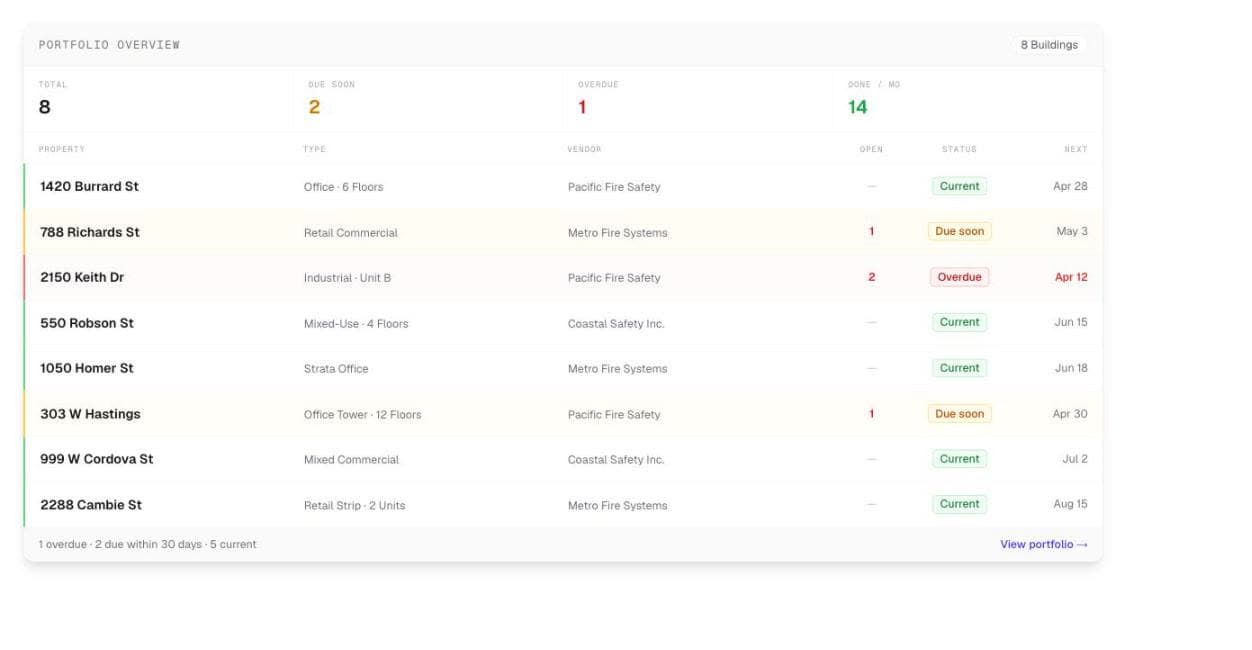
The portfolio overview answers the first two questions at a glance: what is required and when is it due. Each building carries its type, assigned vendor, count of open items, current compliance status and next due date. Overdue and due-soon logic is computed from the inspection schedule rather than maintained by hand.
Action queue
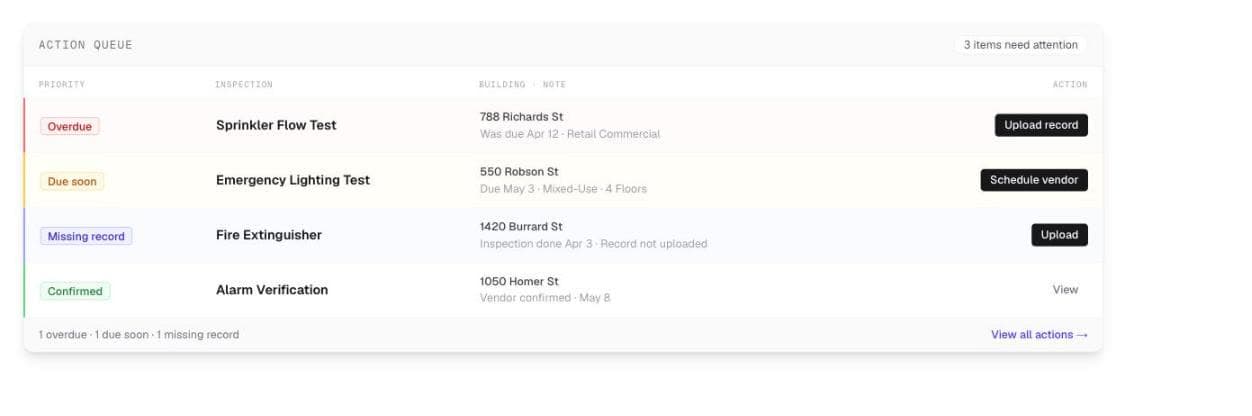
The action queue answers the third and fourth questions. Items are grouped by priority — overdue, due soon, missing record, confirmed — and each row names the building, the reason and the next action, whether that is uploading a record or scheduling a vendor. A completed inspection with no uploaded document is still treated as an open item, since the record is what an auditor asks for.
Scope of the platform
The product organizes obligations, dates, documents and responsibility. It does not replace the professionals who perform inspections or the authorities who set requirements, and the public product page states this directly.
Included
- Track compliance requirements, due dates and inspection history per building
- Store certificates and documents against the inspections they evidence
- Surface overdue, due-soon and missing-record items across a portfolio
- Keep vendor assignments and vendor compliance documents organized
- Separate every organization's records at the database level
Handled by others
- Provide legal or regulatory compliance advice
- Perform, certify or approve inspections
- Replace a qualified contractor, inspector or authority having jurisdiction
- Guarantee regulatory outcomes
Custom software development
Application architecture, relational data modelling and multi-tenant data isolation.
ExploreBusiness automation
Due-date logic, action queues and document workflows built around a real operating process.
ExploreClient portals
Authenticated, organization-scoped access to records, with Row Level Security enforcing the separation in the database.
ExploreThis case study reports the architecture and the work delivered. No customer counts, revenue, retention or compliance outcomes are claimed. The product screens shown here are the interface as rendered on the public product page using seeded demonstration data, so no authenticated session or customer record appears.